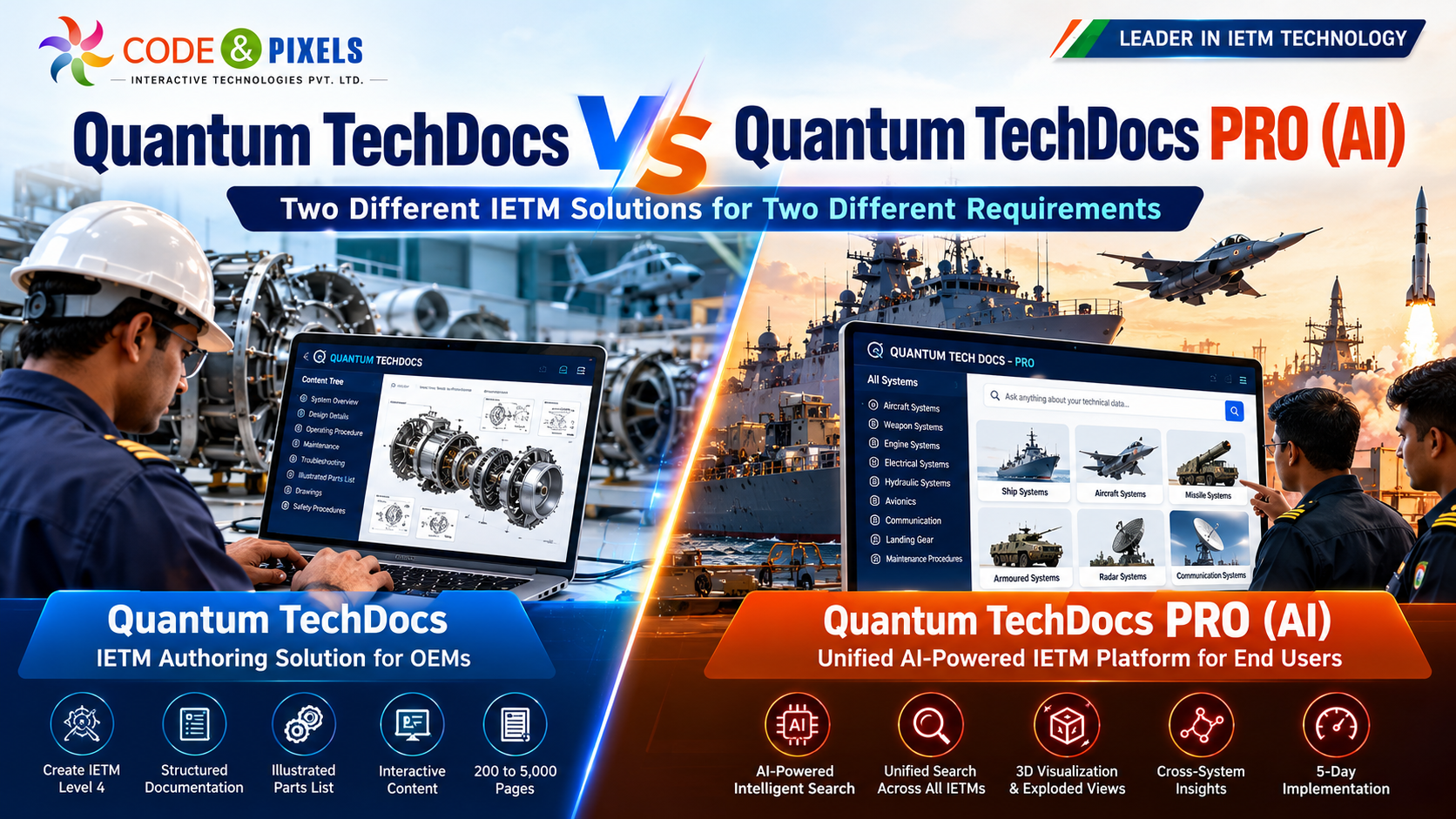
Quantum TechDocs vs Quantum TechDocs PRO (AI)
Two Different IETM Solutions for Two Different Requirements
Introduction
In defence, aerospace and shipbuilding, technical documentation has become increasingly complex.
A modern ship, missile system, aircraft or other defence platform may contain hundreds of systems and subsystems supplied by different OEMs.
Each OEM typically prepares its own IETM Level 4 for the equipment it supplies.
This works well when the requirement is to document an individual product.
But what happens when the end user has to manage 25,000, 30,000 or even 50,000+ pages of technical information received from hundreds of OEMs?
This is where the difference between Quantum TechDocs and Quantum TechDocs PRO (AI) becomes important.
Quantum TechDocs — Designed for OEMs
Quantum TechDocs is primarily designed for individual OEMs that need to create, manage and deliver IETM Level 4 technical documentation.
For example, a radar manufacturer may have 3,000 pages of technical documentation covering:
- System operation
- Maintenance
- Troubleshooting
- Fault isolation
- Parts information
- Repair procedures
- Safety procedures
The OEM develops its IETM using Quantum TechDocs and submits it to the shipyard or Armed Forces as part of the equipment delivery.
Typical requirement
200 to 5,000 pages → Quantum TechDocs
The OEM creates an IETM for its own equipment.
This is the right solution for an individual OEM.

The Shipbuilding Example
Now consider a large ship.
A shipyard may work with 100 or even 150 different OEMs.
For example:
- Engine OEM
- Gearbox OEM
- Radar OEM
- Navigation OEM
- Electrical OEM
- Communication OEM
- Hydraulic OEM
- HVAC OEM
- Weapon-system OEM
- Control-system OEM
- Pump and valve suppliers
The shipyard may ask every OEM:
“Please provide your equipment documentation in IETM Level 4 format.”
As a result, the shipyard may receive:
IETM 1 from OEM 1
IETM 2 from OEM 2
IETM 3 from OEM 3
...
IETM 150 from OEM 150
All these IETMs may be individually effective.
But there is an important problem.
150 IETMs Do Not Automatically Become One IETM
Every OEM develops its IETM independently.
Therefore, different IETMs may have:
- Different databases
- Different interfaces
- Different navigation structures
- Different search mechanisms
- Different terminology
- Different installation environments
Consequently, information remains fragmented.
For example, an engineer investigating a propulsion problem may need information from the:
Propulsion IETM + Cooling IETM + Electrical IETM + Control System IETM
A search performed inside one OEM's IETM generally does not automatically search all the other OEM databases.
The organization therefore has many IETMs, but not necessarily one unified technical-information environment.
The Cost Problem
Consider a simple example.
If developing one IETM costs approximately ₹3 lakh, then:
150 OEMs × ₹3 lakh = ₹4.5 crore
The actual cost will vary depending on documentation volume, complexity and scope, but the overall investment can become several crores.
The organization has spent significant money creating individual IETMs.
Yet it may still have 150 separate technical-information environments.
The individual IETMs are useful.
But using all of them together can remain difficult.
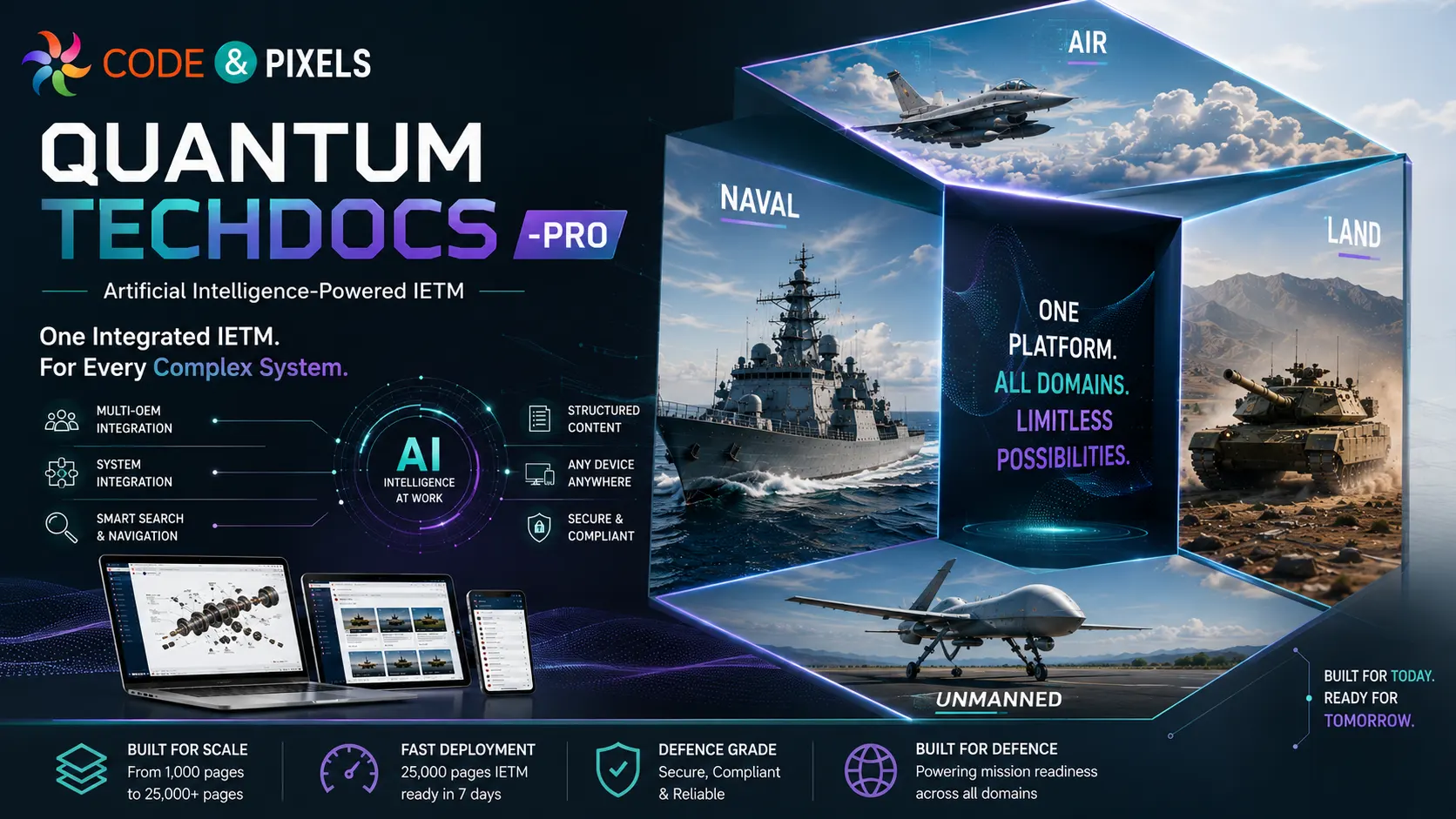
This Is Where Quantum TechDocs PRO (AI) Is Different
Quantum TechDocs PRO (AI) is designed for a fundamentally different requirement.
It is not primarily an OEM IETM authoring solution.
It is designed for the end user—such as:
- Shipyards
- Armed Forces
- Missile-system organizations
- Large defence-system integrators
- Organizations managing 25,000+ pages of technical information
Instead of treating every IETM as a completely separate information island, Quantum TechDocs PRO (AI) is designed to provide a centralized technical-information environment.
A 50,000-Page Example
Imagine a shipyard has:
50,000 pages
of technical information received from different OEMs.
Instead of users manually opening different IETMs and searching them individually, the objective of Quantum TechDocs PRO (AI) is to make this large information base accessible through a unified environment.
A user could ask a question such as:
“What should I check if the propulsion temperature increases during continuous operation?”
The required information may exist across several technical documents belonging to different systems.
AI-assisted information access can help identify relevant information across the larger knowledge base rather than forcing the user to know exactly which OEM's IETM contains the answer.
Why AI Matters
When documentation reaches tens of thousands of pages, conventional keyword search can become increasingly difficult.
A user may search:
“Engine overheating”
while the OEM documentation may use terms such as:
- High coolant temperature
- Over-temperature condition
- Cooling-system malfunction
- Excessive operating temperature
AI can help interpret the user's intent and identify relevant information even when the exact terminology is different.
Therefore, the objective is not simply:
Store more documents.
It is:
Make large volumes of technical information easier to find and use.
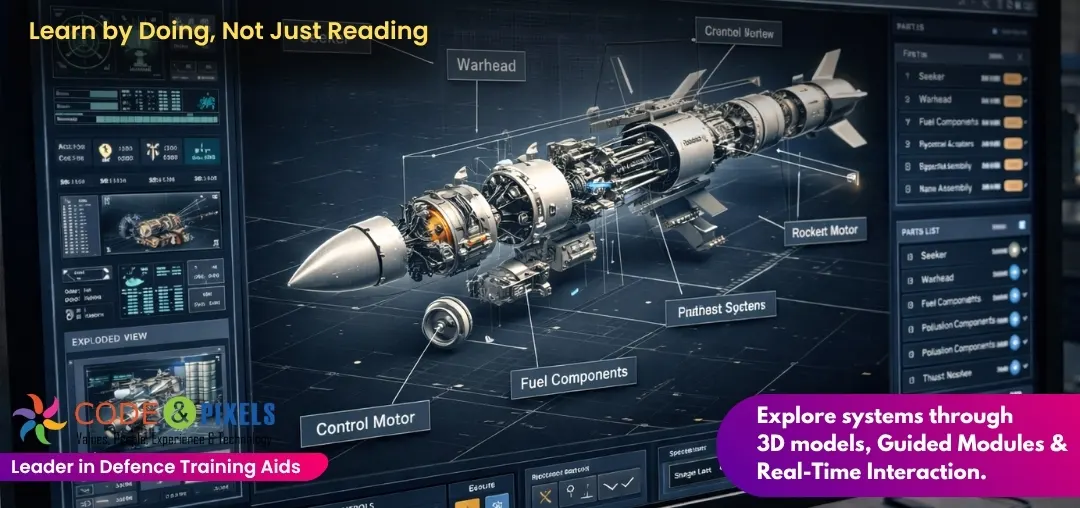
Missile Systems — Another Example
The same challenge exists in complex missile systems.
A missile may contain:
- Guidance
- Navigation
- Propulsion
- Power systems
- Electronics
- Sensors
- Control systems
- Communication systems
- Actuation systems
Different OEMs may supply different subsystems.
Each subsystem can have its own technical documentation.
Imagine the final platform contains 30,000+ pages of information.
A technician does not necessarily want to know:
“Which OEM created this document?”
The technician wants to know:
“What do I need to do to solve this problem?”
This is the type of requirement Quantum TechDocs PRO (AI) is designed to address.
Quantum TechDocs vs Quantum TechDocs PRO (AI)
|
Comparison |
Quantum TechDocs |
Quantum TechDocs PRO (AI) |
|
Primary user |
OEM |
Shipyard / Armed Forces / End User |
|
Typical scale |
200–5,000 pages |
25,000–50,000+ pages |
|
Purpose |
Create & deliver IETM |
Integrate & access large technical information |
|
Environment |
Individual equipment |
Multiple systems / OEMs |
|
Search |
IETM-level |
Large-scale / global information access |
|
AI |
Not the primary requirement |
Core capability |
|
Infrastructure |
Standard |
Higher-end infrastructure recommended |
|
Example |
Radar OEM IETM |
Complete ship technical-information environment |
Reducing the IETM Burden on OEMs
IETM development is also an additional responsibility for OEMs.
An OEM's primary responsibility is to design, develop and manufacture its equipment.
But the OEM may also have to:
- Prepare structured technical documentation
- Convert legacy documentation
- Develop the IETM
- Test the IETM
- Deploy the software
- Maintain the database
- Provide updates and support
When hundreds of OEMs participate in a large platform, this becomes a significant collective effort.
Quantum TechDocs PRO introduces another approach:
Instead of making every OEM build a complete standalone information environment, the end user can establish an enterprise-level technical-information platform.
The Cost Advantage
Suppose a large project is spending approximately ₹5 crore on developing multiple individual IETMs.
Depending on project scope, infrastructure and integration requirements, Quantum TechDocs PRO (AI) can potentially address the same broader information-access requirement at a fraction of the conventional expenditure—with a target of around 10% of the traditional IETM-related cost in suitable scenarios.
The objective is not simply to reduce software cost.
It is to change the architecture of how technical information is managed.
Built on 14 Years of IETM Experience
Quantum TechDocs PRO (AI) is based on Code and Pixels' approximately 14 years of experience in IETM technology.
Code and Pixels has:
- Worked with 50+ OEMs
- Delivered 175+ IETM projects
- Worked extensively with defence technical documentation
- Supported IETM implementations
- Conducted IETM training for Armed Forces personnel
- Provided advisory support related to IETM requirements
This experience has given us an understanding not only of how IETMs are created, but also of the challenges users face after those IETMs are delivered.
We have encountered situations where technically completed IETMs were not fully utilized because of:
- Difficult installation
- Poor usability
- Fragmented databases
- Different OEM interfaces
- Limited cross-system search
- Multiple independent IETM environments
This experience directly influenced the thinking behind Quantum TechDocs PRO.
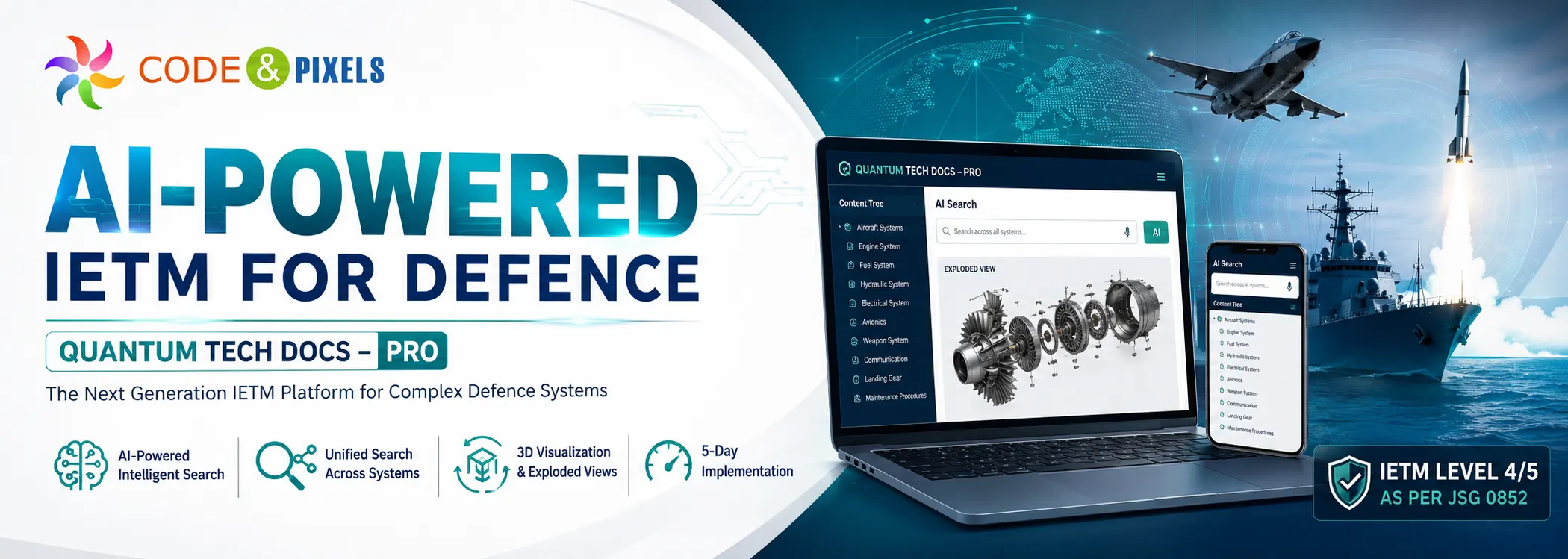
The Next Evolution of IETM
The industry is gradually moving from:
Individual IETMs
to
Integrated Technical Information
and ultimately towards
AI-Assisted Technical Knowledge.
The two Quantum TechDocs products address these different requirements.
Quantum TechDocs
For OEMs — Create and deliver your IETM.
Quantum TechDocs PRO (AI)
For End Users — Access and intelligently use the combined technical information of complex platforms.
Conclusion
If an OEM has 200 to 5,000 pages of technical documentation and needs to deliver an IETM Level 4, Quantum TechDocs is designed for that requirement.
If a shipyard, Armed Forces organization or missile-system organization has 25,000, 30,000, 50,000+ pages coming from multiple OEMs, the challenge becomes much larger than simply creating individual IETMs.
It becomes an enterprise technical-information problem.
That is where Quantum TechDocs PRO (AI) comes in.
Quantum TechDocs helps OEMs deliver IETMs. Quantum TechDocs PRO (AI) helps end users intelligently access the combined technical knowledge of complex platforms.
From Individual IETMs → Integrated Technical Information → AI-Assisted Technical Knowledge.
That is the next evolution of IETM technology.
Learn More or Request a Demo
Website: www.codeandpixels.net
Email: ietm@codeandpixels.net
Phone: +91 98495 27706
 |
GOPI KRISHNA GUDIVADA Leading the R&D and Project divisions at Code and Pixels and Digital Teacher, driving innovation in e-learning, IETM software, and Defence documentation solutions. With 23 years in content development and 15 years in Defence technical documentation, I bring deep expertise in designing and implementing IETM solutions aligned with JSG 0852 and S1000D standards. Passionate about creating world-class digital training systems for the Indian Armed Forces and advancing the standards of e-learning in India.    |
____________________________________________________________________________________________________________________________________
Frequently Asked Questions
1. What is the main difference between Quantum TechDocs and Quantum TechDocs PRO (AI)?
Quantum TechDocs focuses on creating and delivering IETMs, while Quantum TechDocs PRO (AI) is designed for integrating and accessing large-scale technical information with AI capabilities.
2. Who is Quantum TechDocs designed for?
Quantum TechDocs is primarily suitable for OEMs working with individual equipment and typical IETM projects of around 200–5,000 pages.
3. Who can benefit from Quantum TechDocs PRO (AI)?
Quantum TechDocs PRO (AI) is suited for shipyards, Armed Forces, and end users managing multiple systems, OEMs, and large technical-information environments.
4. Is AI a core capability of Quantum TechDocs PRO (AI)?
Yes. AI is a core capability of Quantum TechDocs PRO (AI), supporting access to large-scale technical information and making complex technical information easier to access.


