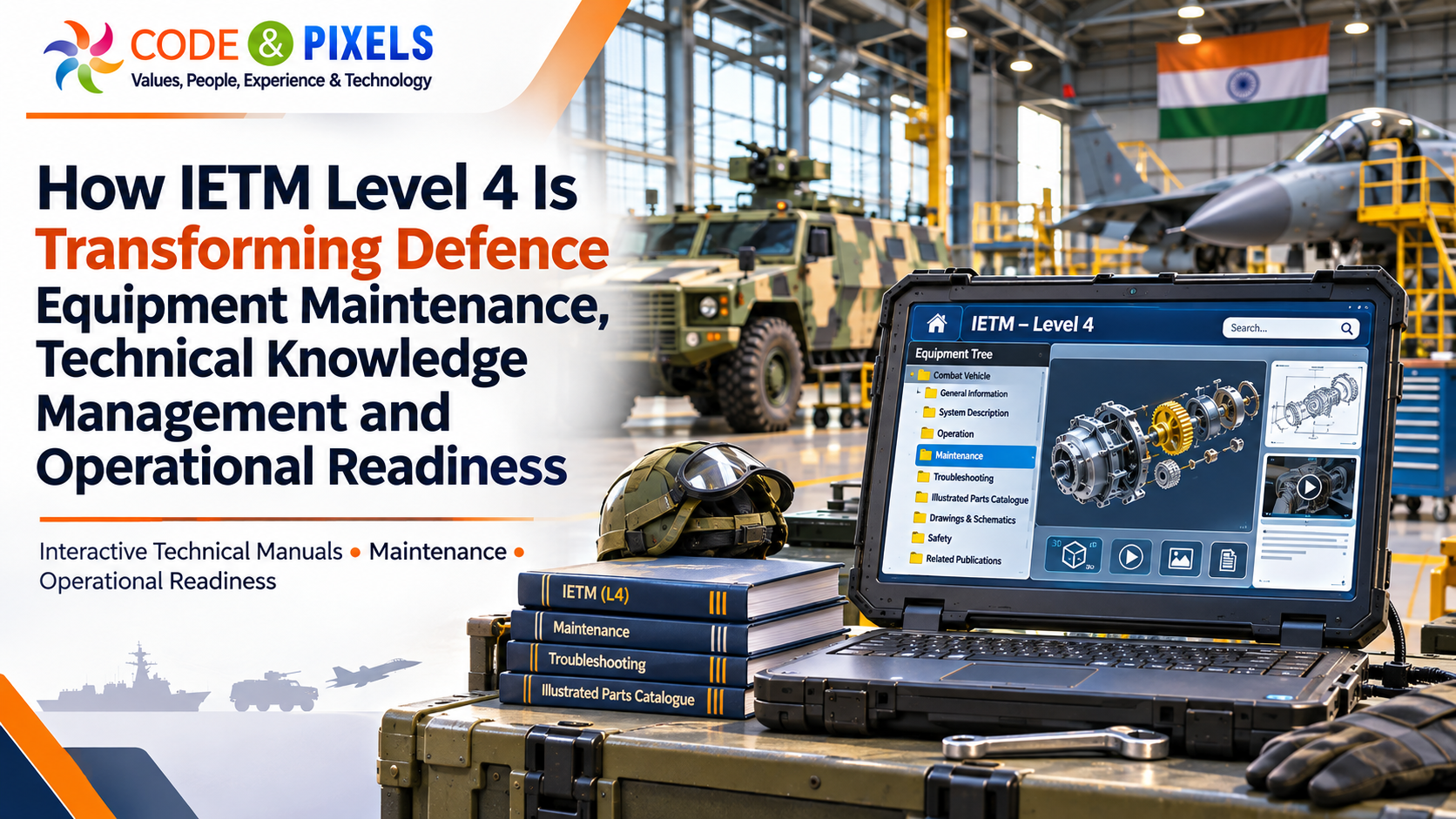
How IETM Level 4 Is Transforming Defence Equipment Maintenance, Technical Knowledge Management and Operational Readiness
Why the Indian Armed Forces Need More Than Technical Manuals in Modern Warfare
Modern warfare is no longer determined only by the strength of weapons, platforms or military equipment. It is equally dependent on how effectively these systems are operated, maintained, repaired and supported throughout their service life.
From missile systems and combat vehicles to naval platforms, surveillance radars, UAVs and sophisticated aerospace equipment, today's defence systems are becoming increasingly complex. Each system involves hundreds or thousands of components, interconnected subsystems, operating procedures, maintenance schedules, troubleshooting instructions, technical drawings and safety requirements.
For the personnel operating and maintaining this equipment, one thing is essential: the right technical information must be available at the right time.
Consider a situation where a maintenance team is attending to a technical fault in a missile launcher, a naval propulsion system or a high-mobility military vehicle. The technician needs to identify the relevant component, understand the fault, refer to the correct maintenance procedure, examine the associated drawing and follow the prescribed repair instructions.
Traditionally, this information may be spread across multiple printed manuals, PDF documents, drawings and maintenance publications. Finding the correct information can consume valuable time, particularly when the equipment is complex and the personnel are working under operational pressure.
This is where an Interactive Electronic Technical Manual (IETM) Level 4, developed in accordance with the Indian Defence Standard JSG 0852, becomes an important operational resource.
With Quantum TechDocs – IETM Publishing Suite, developed by Code and Pixels Interactive Technologies Pvt. Ltd., defence equipment documentation can be transformed into an organized, interactive and searchable digital knowledge environment.
The objective is simple: reduce the time spent searching for technical information and help Armed Forces personnel concentrate on operating, maintaining and restoring their equipment.
1. The Real Challenge: Finding Technical Information When It Matters
Every defence equipment system is supplied with technical documentation. However, the usefulness of this documentation depends not only on its technical accuracy but also on how quickly the end user can access and understand it.
Consider the typical documentation associated with a complex defence system:
- Equipment technical descriptions and specifications.
- System and subsystem operating instructions.
- Installation and commissioning procedures.
- Preventive and corrective maintenance instructions.
- Fault diagnosis and troubleshooting procedures.
- Illustrated parts catalogues and component identification.
- Electrical, hydraulic and mechanical schematics.
- Safety precautions and operating limitations.
- Inspection schedules and service procedures.
- Technical drawings, videos and supporting publications.
When these documents are maintained independently, personnel may need to move between different publications to understand one maintenance activity.
An IETM Level 4 brings this information into a structured digital environment.
Instead of navigating through multiple physical manuals, users can search for a component, select a subsystem, follow hyperlinks to related procedures, view technical drawings and access associated multimedia information from a single platform.
The biggest advantage is not merely converting paper into digital format. It is connecting technical knowledge so that users can find the information they need without unnecessary searching.

2. How IETM Level 4 Saves Time for the Armed Forces
The practical value of an IETM becomes clear when we examine the daily activities of operators, technicians, maintainers and technical supervisors.
A. Faster identification of equipment components
In conventional manuals, identifying a particular component may involve checking an index, referring to a drawing and then searching another section for its description.
With Quantum TechDocs, the equipment documentation can be organized into interactive modules, hierarchical content structures, drawings and cross-referenced information.
Users can search for component names, part references or technical terms and navigate directly to relevant information.
Where interactive drawings and hotspots are configured, selecting a component can display its associated description, image or related information.
This reduces unnecessary movement between documents.
B. Faster fault diagnosis and troubleshooting
When a fault occurs, maintenance personnel need access to the relevant troubleshooting guide, inspection procedure and corrective maintenance instructions.
A structured IETM allows users to:
- Search for the relevant fault or technical term.
- Open the associated troubleshooting procedure.
- Access linked diagrams and illustrations.
- Navigate to related maintenance instructions.
- Refer to relevant manuals and supporting documents.
This makes technical information easier to retrieve and helps maintenance personnel follow the prescribed documentation more efficiently.
C. Reduced dependence on physical manuals
Carrying multiple technical publications for a complex system can be inconvenient, especially when several subsystems are involved.
An IETM provides a centralized digital repository containing technical information, manuals, drawings, videos and other supporting publications.
Depending on the deployment configuration, the IETM can be made available on standalone systems or secure defence intranets, including offline environments.
D. Faster understanding through interactive illustrations
A written description alone may not always be sufficient to understand a complicated assembly.
Quantum TechDocs supports images, interactive drawings, hotspots and 3D viewing capabilities.
Where the OEM supplies suitable 3D STEP files, users can view supported equipment models with 360-degree rotation. Exploded and highlighted views can also be developed as an additional service.
This is particularly useful when understanding component locations, equipment assemblies and the relationship between different parts.
E. Better continuity between OEMs and end users
The OEM develops the equipment and possesses detailed technical knowledge. The Armed Forces operate and maintain the equipment in the field.
An IETM provides a common, structured technical reference for both.
User annotations and comments can be submitted for administrator review. The OEM can examine the feedback and incorporate approved technical changes into subsequent revisions.
This creates a more systematic mechanism for maintaining and improving the equipment's technical knowledge base.
3. IETM: A Digital Library for the Entire Life Cycle of Defence Equipment
One of the most important benefits of IETM Level 4 is its ability to function as a centralized digital technical library.
An IETM should not be viewed merely as an electronic replacement for a printed maintenance manual. It is a structured repository of technical knowledge associated with a particular equipment system.
For example, an IETM for a naval platform or missile system can bring together multiple categories of technical information.
What does this digital library contain?
1. Core technical knowledge
Equipment descriptions, system architecture, technical specifications, operating principles and subsystem information.
2. Operation and maintenance manuals
Operating instructions, maintenance procedures, inspection schedules, servicing requirements and safety precautions.
3. Technical drawings
Mechanical drawings, electrical schematics, hydraulic diagrams, assembly illustrations and component identification references.
4. Multimedia knowledge
Videos, images, animations and other supporting visual material that explain equipment operation and maintenance.
5. Parts and component information
Component descriptions, illustrated parts information and cross-references between drawings and technical content.
6. Troubleshooting knowledge
Fault identification procedures, diagnostic information, inspection instructions and corrective maintenance references.
7. Revision and historical information
Revision records, updated publications, user annotations and controlled documentation changes.
Why does this matter?
Defence equipment remains in service for many years. During this period, maintenance personnel may change, equipment configurations may be upgraded and technical publications may undergo revisions.
Without a structured knowledge repository, valuable technical information can become difficult to locate or maintain consistently.
An IETM provides a centralized and organized information environment that helps preserve equipment knowledge beyond individual personnel and individual maintenance assignments.
It supports knowledge continuity throughout the equipment's operational life cycle.
The IETM becomes a digital knowledge asset for the OEM as well as the Armed Forces.
4. Why IETM Level 4 Is Important: Moving Beyond Conventional Electronic Manuals
Not every electronic manual is an IETM Level 4.
A scanned PDF or a collection of digital documents may make information available electronically, but it does not automatically provide structured navigation, database-driven content, cross-references and interactive technical information.
IETM Level 4, in accordance with JSG 0852, provides a more structured and interconnected approach to technical documentation.
Quantum TechDocs is developed around this requirement.
Its important capabilities include:
|
Capability |
Practical benefit |
|
Structured database-driven content |
Organizes information into searchable modules and topics |
|
Advanced search |
Helps users locate technical information quickly |
|
Hyperlinks and cross-references |
Connects related procedures, components and publications |
|
Interactive hotspots |
Displays related text, images and videos |
|
Technical drawing integration |
Makes component identification easier |
|
360-degree 3D viewing |
Helps users understand equipment assemblies |
|
PDF and manual integration |
Maintains access to supporting technical publications |
|
Video integration |
Provides visual explanations of procedures |
|
Bookmarking |
Allows users to revisit important information |
|
Annotations and comments |
Supports technical feedback and communication |
|
Revision history |
Maintains records of documentation changes |
|
Role-based access |
Controls information access according to user responsibilities |
|
User activity tracking |
Helps administrators monitor usage and access history |
|
Backup and restore |
Supports protection and recovery of IETM data |
The platform consists of three principal modules:
Authoring Module: Used by the OEM or authorized documentation team to create, structure, update and publish technical information.
Administrator Module: Used to manage users, assign roles, monitor activities, manage backups and generate reports.
Viewer Module: Used by operators, maintainers and other authorized end users to access the published technical information.
Quantum TechDocs also supports browser-based access, configurable deployment, secure intranet environments and offline usage as appropriate to the project configuration.
Its technical architecture includes an HTML5-based viewing environment, application services and a database layer.

5. The Role of IETM in Modern Warfare
Modern military operations depend on the availability and effective use of complex equipment.
A missile system, UAV, naval platform, radar installation or combat vehicle represents a substantial investment in engineering, manufacturing, integration and testing.
However, the equipment's operational value also depends on the ability of personnel to operate and maintain it correctly.
This is where technical knowledge management becomes important.
Operational readiness
Equipment availability is influenced by maintenance quality, timely servicing, fault identification and access to the correct technical procedures.
A structured IETM supports these activities by making technical information readily accessible.
Faster technical familiarization
When new personnel are assigned to equipment, they need to understand its architecture, operation, maintenance requirements and safety procedures.
An interactive technical manual with organized content, drawings, videos and cross-references can support familiarization and reduce dependence on searching through multiple publications.
Knowledge continuity
Military equipment can remain in service across multiple personnel postings and maintenance cycles.
An IETM helps preserve the technical knowledge associated with equipment in a consistent digital repository.
Standardized technical reference
A properly developed IETM provides a structured reference for authorized users, reducing ambiguity arising from different document formats and disconnected publications.
Lifecycle documentation management
As equipment undergoes approved upgrades, modifications and technical revisions, its supporting documentation must also be maintained.
An IETM provides a framework for managing revisions and publishing updated technical information through authorized processes.
In modern warfare, equipment readiness is not just about having advanced technology. It is also about ensuring that the people responsible for that technology have reliable technical knowledge at their fingertips.
6. Why Defence OEMs Should Take IETM Development Seriously
For a defence OEM, delivering equipment is only one part of the responsibility.
The equipment must also be supported with appropriate technical documentation for operation, maintenance, training and lifecycle support.
IETM development should therefore be treated as an important engineering documentation activity, not as a last-minute software conversion exercise.
An experienced IETM development partner understands that every equipment system has its own documentation structure, technical terminology, maintenance hierarchy and end-user requirements.
The partner must be capable of understanding OEM inputs, organizing technical information, developing structured content, integrating multimedia and validating the final IETM.
A technically sophisticated software platform alone is not sufficient.
Successful IETM delivery requires three things: a capable publishing platform, a strong documentation development team and practical experience in defence technical publications.
This is where Code and Pixels brings its experience to the table.
7. Code and Pixels: 14 Years of Exclusive IETM Experience
Code and Pixels Interactive Technologies Pvt. Ltd. is a Hyderabad-based technology company with 14 years of dedicated experience in Interactive Electronic Technical Manual development and defence technical documentation.
Over these years, the company has worked with defence production agencies, public sector organizations, defence laboratories, shipbuilding organizations, aerospace companies and private defence OEMs.
Its experience extends across multiple equipment categories, including:
- Missile systems and missile support equipment.
- Military vehicles and specialized transporter systems.
- UAVs, drones and unmanned systems.
- Naval platforms and shipboard equipment.
- Propulsion and auxiliary systems.
- Radar and surveillance systems.
- Aerospace electronics and avionics.
- Hydraulic, pneumatic and mechanical equipment.
- Fire-fighting and other naval support systems.
This experience has helped Code and Pixels understand the different documentation challenges faced by OEMs and end users.
Experience that goes beyond software development
IETM development is not simply about uploading manuals into software.
It requires an understanding of:
- How defence technical documentation is structured.
- How equipment systems and subsystems should be organized.
- How maintenance procedures and troubleshooting information must be presented.
- How technical drawings should be connected with related content.
- How cross-references and interactive elements should function.
- How documentation revisions should be managed.
- How the final IETM should be validated for end-user requirements.
- How technical knowledge should be presented so that operators and maintainers can use it effectively.
After working on more than 125 IETM projects, Code and Pixels has developed practical knowledge of these requirements across different categories of defence equipment.
The experience gained from one equipment category also helps the team understand documentation requirements in another.
A missile system, a naval pump, a military vehicle and a UAV may have completely different engineering characteristics. However, each requires a structured approach to technical information, equipment hierarchy, operating procedures and maintenance documentation.
This cross-domain experience is an important advantage when executing IETM projects.
A proven defence and OEM ecosystem
Code and Pixels' published client portfolio includes organizations such as:
Defence production agencies and laboratories
- Bharat Dynamics Limited (BDL).
- Research Centre Imarat (RCI), DRDO.
- Electronics Corporation of India Limited (ECIL).
- Defence Research and Development Laboratory (DRDL).
- Advanced Systems Laboratory (ASL).
Leading defence and aerospace OEMs
- Tata Advanced Systems Limited.
- Tata Power SED.
- Mahindra Defence Systems.
- L&T / BrahMos Aerospace.
- ideaForge Technology.
- Raphe mPhibr.
- Asteria Aerospace.
- Ashok Leyland Defence Systems.
- Zen Technologies.
- Data Patterns.
- Ananth Technologies.
Shipbuilding and naval equipment ecosystem
- MAN Energy Solutions.
- DESMI India.
- Marine Electricals.
- FläktGroup India.
- KSB.
- Veljan Hydrair.
- Johnson Controls.
- Hi-Point Services.
The portfolio demonstrates the diversity of equipment documentation handled by Code and Pixels and its engagement with organizations across the defence, aerospace and naval sectors.
The company website's published client portfolio also describes Quantum TechDocs as being used by more than 100 OEMs and defence laboratories, with over 300 IETMs delivered across different projects and equipment categories.
For an OEM evaluating an IETM development partner, this breadth of exposure is significant. It means the development team is familiar with the documentation expectations associated with different types of defence equipment rather than learning the domain from scratch for every project.
8. Quantum TechDocs – Developed Around the Requirements of Defence Documentation
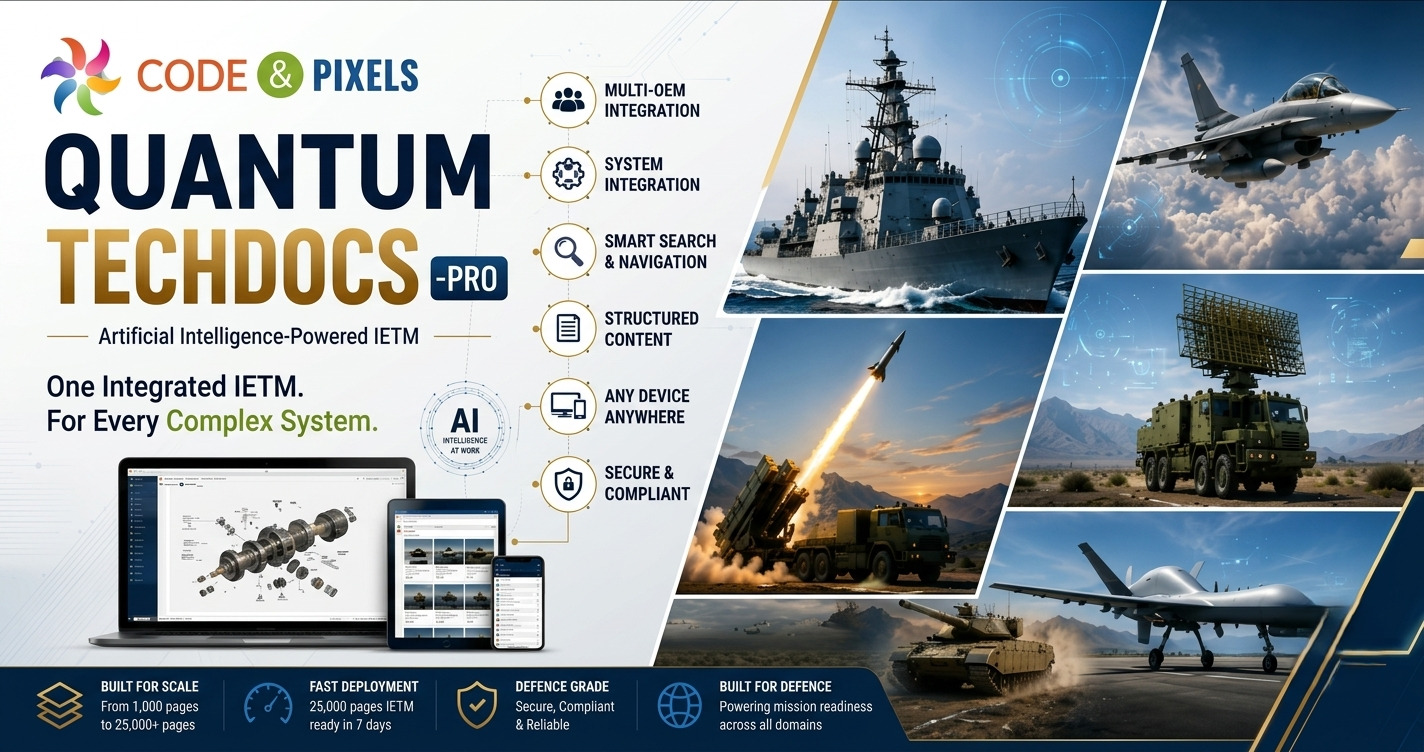
Quantum TechDocs is Code and Pixels' IETM Publishing Suite, developed to support IETM Level 4 documentation in accordance with JSG 0852.
The platform has been designed for defence OEMs, shipyards, aerospace manufacturers and system integrators.
It provides an integrated environment for creating, managing, publishing and accessing interactive technical documentation.
Three modules. One integrated IETM ecosystem.
1. Authoring Module
The Authoring Module enables the OEM or authorized documentation team to create and manage structured IETM content.
It supports:
- HTML5-based content authoring.
- Database-driven content organization.
- Integration of images, tables and multimedia.
- Hyperlinks and cross-references.
- Text, image and video hotspots.
- Index and table-of-contents generation.
- Glossary and abbreviation management.
- PDF and supporting manual integration.
- Content revision and updates.
The objective is to enable structured technical documentation development without making the OEM dependent on manual coding for routine content authoring.
2. Administrator Module
The Administrator Module provides controlled management of the IETM environment.
It supports:
- User creation and management.
- Operator and maintainer role assignments.
- Access control.
- Login and logout history.
- User activity monitoring.
- Search history and document access tracking.
- Annotation management.
- Backup and restore.
- Controlled printing with timestamped watermarks.
- Consolidated activity reports.
These capabilities help organizations maintain better control over their technical documentation environment.
3. Viewer Module
The Viewer Module is the interface used by authorized end users.
It provides:
- Advanced content search.
- Hierarchical navigation.
- Interactive drawings.
- Hyperlinks and cross-references.
- Integrated manuals and PDF publications.
- Video and multimedia viewing.
- 3D viewing capabilities.
- Bookmarks and annotations.
- Related-content navigation.
- Glossary and abbreviation access.
- Configurable viewing themes.
The Viewer is designed to make technical information easier to access and understand.
Why Quantum TechDocs?
The platform combines structured documentation, interactive viewing, administrative control and technical knowledge management.
It is designed around the practical requirements of defence documentation and provides OEMs with a dedicated IETM publishing environment rather than a generic document management system.
More information: https://www.codeandpixels.net/ietm-level-4-quantum-techdocs-publishing-suite
9. What Makes Code and Pixels a Dependable IETM Development Partner?
When an OEM assigns an IETM project, the selection of the development partner can influence the quality, usability and long-term maintainability of the delivered documentation.
Code and Pixels brings together four important strengths.
1. Domain experience
Fourteen years of exclusive involvement in IETM development provides a strong understanding of defence technical documentation requirements.
2. Multi-equipment experience
Experience across missile systems, vehicles, UAVs, shipyard equipment, naval systems and aerospace products helps the team understand different equipment documentation structures.
3. Dedicated IETM publishing technology
Quantum TechDocs provides an integrated authoring, administration and viewing environment designed for JSG 0852-based IETM development.
4. Project execution experience
Having executed more than 125 IETM projects, the company understands the practical challenges involved in receiving OEM inputs, structuring content, converting legacy publications, integrating drawings and multimedia, validating the final product and supporting deployment.
For an OEM, this means working with a team that understands not only the software but also the technical documentation process behind the software.
More than a software supplier – a technical documentation partner
Code and Pixels believes that the value of an IETM is ultimately measured by how effectively it serves the people who use the equipment.
The objective is not simply to deliver an application and close a project.
It is to help the OEM create a reliable technical knowledge base that can support the equipment throughout its operational life.
From understanding the initial documentation inputs to structuring the content, developing interactive elements, validating the final IETM and providing end-user support, Code and Pixels works towards making the complete IETM development process more organized and dependable.
10. The Future of Defence Technical Documentation Is Structured, Interactive and Knowledge-Driven
Indian defence manufacturing is expanding across missiles, aerospace, naval platforms, military vehicles, UAVs, surveillance equipment and advanced electronic systems.
As the complexity of these systems increases, the volume of technical documentation required to support them will also grow.
The industry must move towards documentation systems that are easier to search, navigate, maintain and update.
IETM Level 4 provides an important foundation for this transition.
It helps transform disconnected technical publications into an organized digital knowledge repository, making equipment information more accessible to authorized users.
For Armed Forces personnel, this means quicker access to operating and maintenance information.
For OEMs, it means a structured and maintainable documentation delivery system.
For shipyards and system integrators, it means better organization of technical publications across different equipment packages.
And for the defence ecosystem as a whole, it means preserving engineering knowledge and making it available throughout the equipment lifecycle.
Conclusion: When Experience Matters, Choose an IETM Partner Who Understands Defence
An IETM project is not just another software assignment. It is an important part of the technical documentation and lifecycle support of defence equipment.
The development partner must understand defence standards, equipment documentation, technical content structuring, OEM expectations and the practical needs of Armed Forces end users.
With 14 years of exclusive IETM experience, more than 125 executed IETM projects and the Quantum TechDocs – IETM Publishing Suite, Code and Pixels has built a strong foundation in the Indian defence technical documentation ecosystem.
Our experience across missile systems, military vehicles, UAVs, naval equipment, shipbuilding and aerospace documentation gives us the confidence to take up diverse and complex IETM assignments.
If you are a defence OEM, shipyard, aerospace manufacturer or system integrator planning an IETM Level 4 project, Code and Pixels is ready to work with you.
We understand the documentation requirements. We understand the technology. Most importantly, we understand the importance of making technical knowledge accessible to the people who depend on it.
Code and Pixels Interactive Technologies Pvt. Ltd.
14 Years of Exclusive IETM Experience | 125+ IETM Projects | Quantum TechDocs – IETM Publishing Suite
Learn More or Request a Demo
Website: www.codeandpixels.net
Quantum TechDocs: https://www.codeandpixels.net/ietm-level-4-quantum-techdocs-publishing-suite
IETM Client Portfolio: https://www.codeandpixels.net/quantum-techdocs-ietm-client-list
Email: ietm@codeandpixels.net
Phone: +91 98495 27706
 |
GOPI KRISHNA GUDIVADA Leading the R&D and Project divisions at Code and Pixels and Digital Teacher, driving innovation in e-learning, IETM software, and Defence documentation solutions. With 23 years in content development and 15 years in Defence technical documentation, I bring deep expertise in designing and implementing IETM solutions aligned with JSG 0852 and S1000D standards. Passionate about creating world-class digital training systems for the Indian Armed Forces and advancing the standards of e-learning in India.    |


