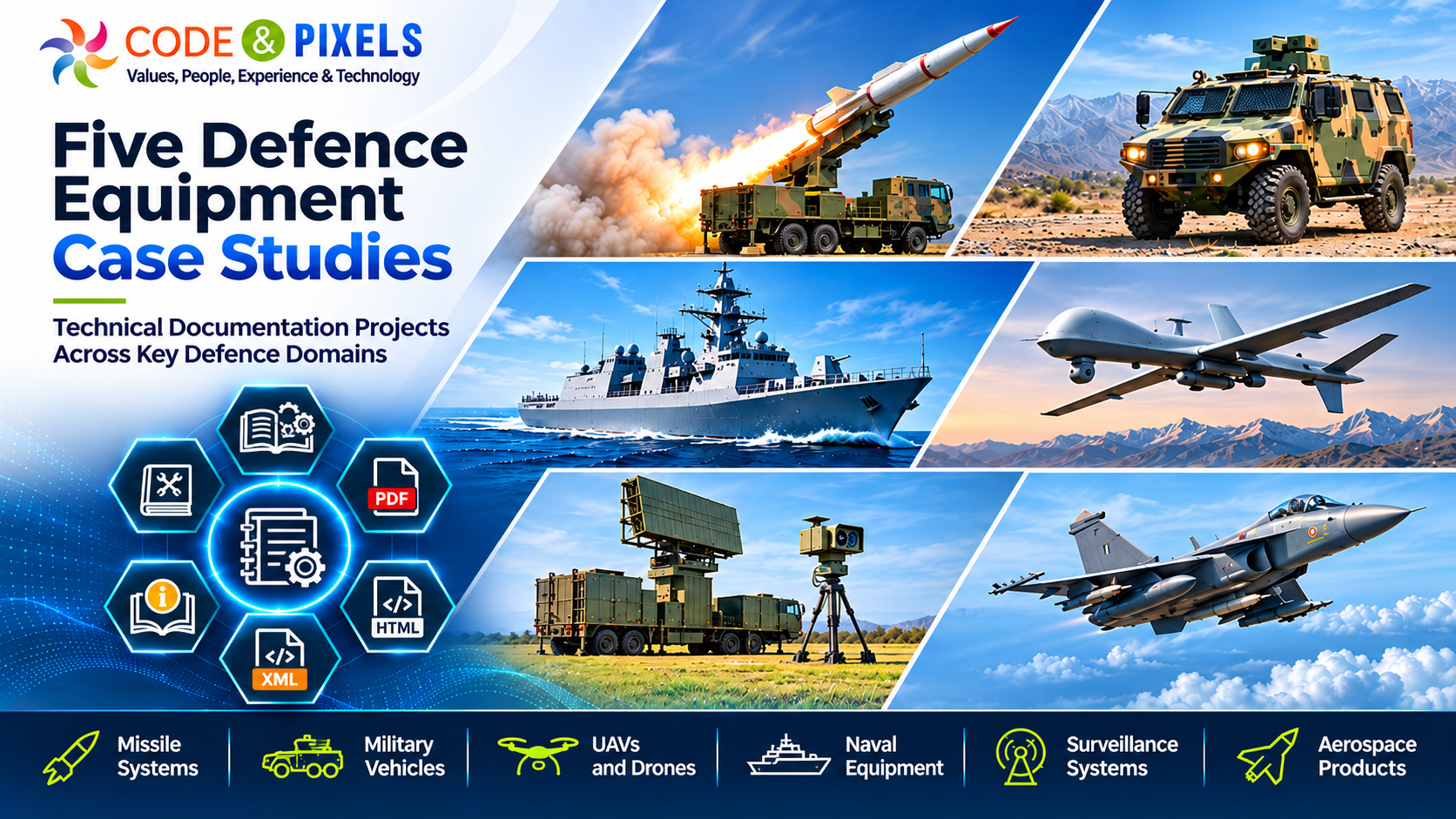
Five Defence Equipment Case Studies: Where IETM Makes a Practical Difference
The real strength of an IETM can be understood by examining the different types of equipment used by the Indian Armed Forces.
Code and Pixels has worked on technical documentation projects covering missile systems, military vehicles, UAVs, naval equipment, surveillance systems and aerospace products.
The following examples illustrate how structured IETM documentation can support the operation and maintenance of such equipment. They are representative application scenarios based on the equipment categories and projects in the Code and Pixels portfolio, not claims of independently measured field-performance improvements.
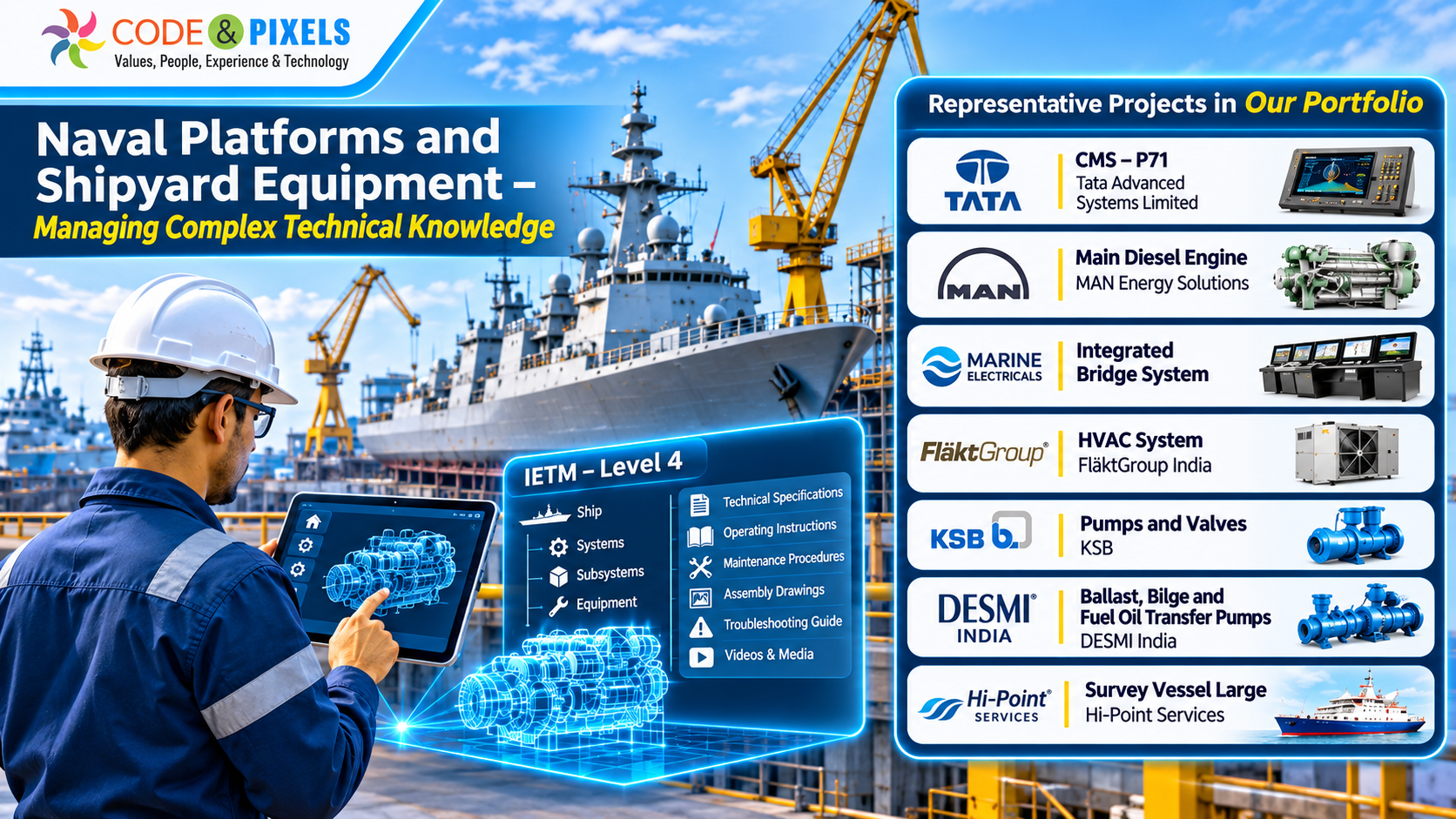
Case Study 1: Naval Platforms and Shipyard Equipment – Managing Complex Technical Knowledge
Representative projects in the Code and Pixels portfolio:
- CMS – P71, supplied by Tata Advanced Systems Limited.
- Main Diesel Engine, MAN Energy Solutions.
- Integrated Bridge System, Marine Electricals.
- HVAC System, FläktGroup India.
- Pumps and valves, KSB.
- Ballast, bilge and fuel oil transfer pumps, DESMI India.
- Survey Vessel Large, Hi-Point Services.
The documentation challenge
Naval platforms involve numerous interconnected mechanical, electrical, propulsion, control, hydraulic and auxiliary systems.
A ship's technical documentation may include equipment manuals, installation drawings, operating instructions, maintenance schedules, safety information, troubleshooting procedures and supporting publications from multiple equipment manufacturers.
For a maintenance team, finding the right information across these different publications can be time-consuming.
How IETM helps
A Level 4 IETM can organize technical publications according to the ship, system, subsystem and equipment hierarchy.
For example, a maintenance technician working on a bilge pump can access:
- Equipment specifications and technical descriptions.
- Operating and maintenance instructions.
- Relevant assembly drawings.
- Component identification information.
- Inspection and servicing procedures.
- Associated manuals and videos.
- Relevant troubleshooting references.
Similarly, documentation for the main diesel engine, HVAC, bridge systems and other auxiliary equipment can be organized into appropriate modules.
The practical benefit
Instead of treating each technical publication as an isolated document, the shipyard and end user can access a connected digital technical library.
For shipyards and naval equipment OEMs, this also creates a consistent documentation structure across multiple equipment packages.
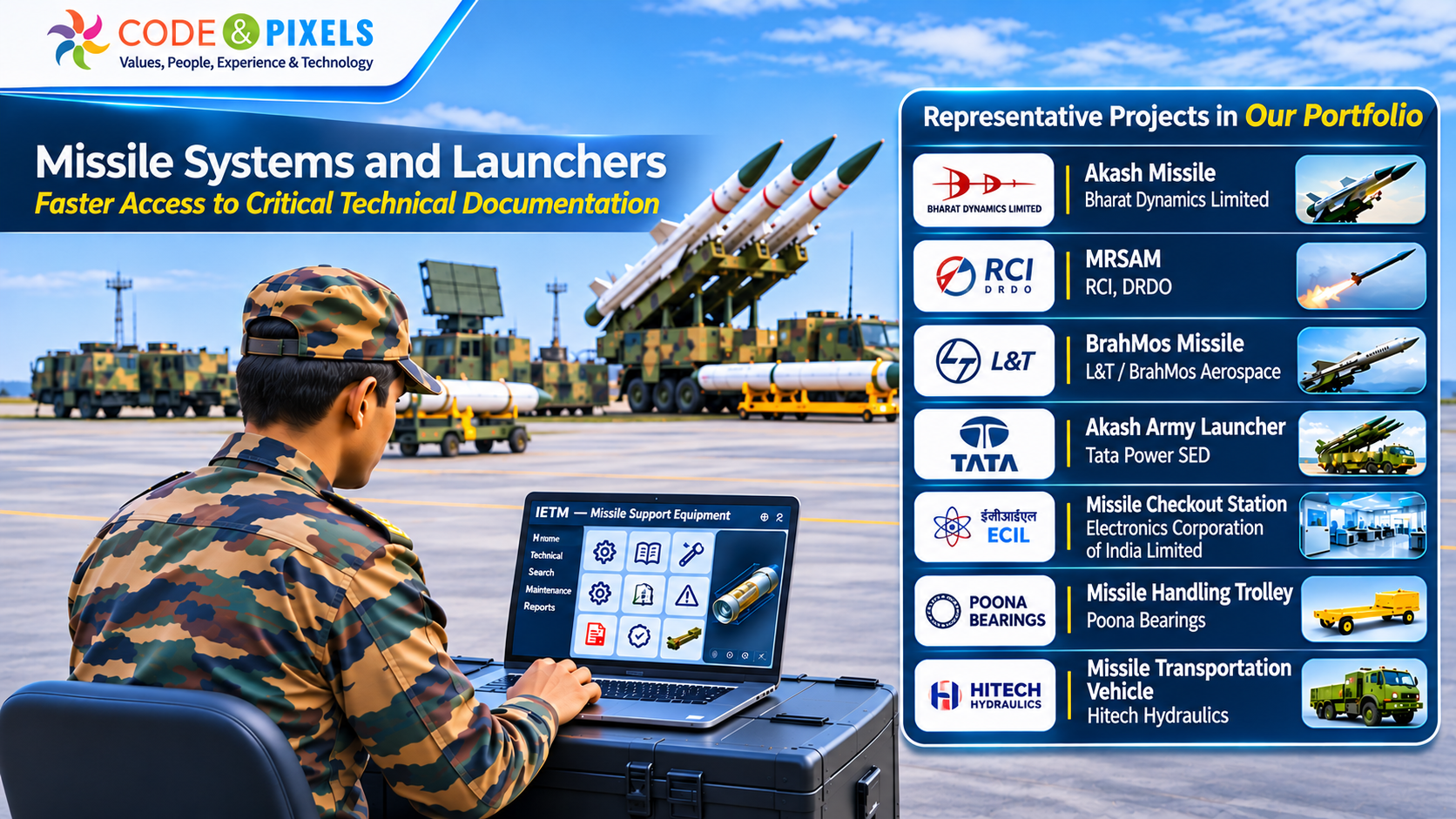
Case Study 2: Missile Systems and Launchers – Faster Access to Critical Technical Documentation
Representative projects in the Code and Pixels portfolio:
- Akash Missile – Bharat Dynamics Limited.
- MRSAM – RCI, DRDO.
- BrahMos Missile – L&T / BrahMos Aerospace.
- Akash Army Launcher – Tata Power SED.
- Missile Checkout Station – Electronics Corporation of India Limited.
- Missile Handling Trolley – Poona Bearings.
- Missile Transportation Vehicle – Hitech Hydraulics.
The documentation challenge
Missile systems involve sophisticated equipment, launch infrastructure, transportation arrangements, electrical and electronic systems, support vehicles and specialized maintenance requirements.
Different subsystems have their own operating procedures, inspection requirements, maintenance publications and technical drawings.
Personnel responsible for these systems require access to the correct documentation for the particular equipment and approved maintenance activity.
How IETM helps
Quantum TechDocs can organize the technical information into separate, interconnected modules.
For example, a missile support equipment IETM can contain:
- Equipment descriptions and specifications.
- Operating instructions.
- Preventive maintenance information.
- Component identification drawings.
- Inspection and servicing procedures.
- Troubleshooting documentation.
- Supporting PDF publications.
- Revision and technical change information.
Hyperlinks and cross-references allow users to navigate between related topics.
Where suitable technical drawings and 3D models are available, interactive viewing can further assist component understanding.
The practical benefit
The maintenance team spends less time searching through separate documents and has a structured reference for the approved technical procedures.
For OEMs, a properly structured IETM also provides a consistent method of delivering equipment documentation to the relevant defence end user.
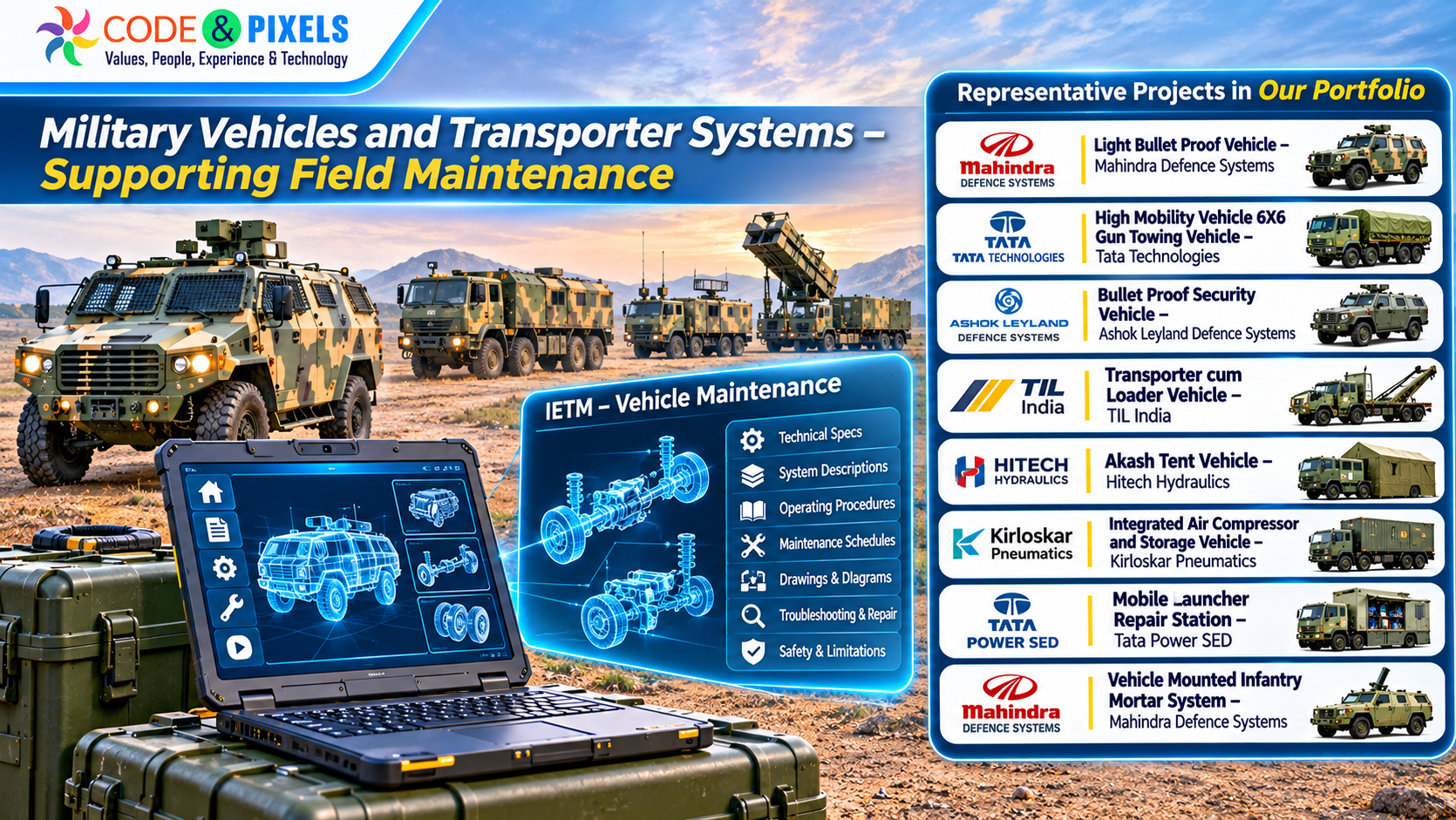
Case Study 3: Military Vehicles and Transporter Systems – Supporting Field Maintenance
Representative projects in the Code and Pixels portfolio:
- Light Bullet Proof Vehicle – Mahindra Defence Systems.
- High Mobility Vehicle 6X6 Gun Towing Vehicle – Tata Technologies.
- Bullet Proof Security Vehicle – Ashok Leyland Defence Systems.
- Transporter cum Loader Vehicle – TIL India.
- Akash Tent Vehicle – Hitech Hydraulics.
- Integrated Air Compressor and Storage Vehicle – Kirloskar Pneumatics.
- Mobile Launcher Repair Station – Tata Power SED.
- Vehicle Mounted Infantry Mortar System – Mahindra Defence Systems.
The documentation challenge
Military vehicles operate in demanding environments and require regular inspection, servicing and maintenance.
A single vehicle may contain mechanical assemblies, electrical systems, hydraulic arrangements, engine-related components, control systems and specialized equipment.
When a vehicle is unavailable due to a technical fault, maintenance personnel need to identify the affected subsystem and refer to the correct servicing and repair information.
How IETM helps
A vehicle-specific IETM can provide structured access to:
- Vehicle technical specifications.
- System and subsystem descriptions.
- Operating procedures.
- Routine inspection and maintenance schedules.
- Mechanical and electrical drawings.
- Component identification information.
- Troubleshooting and repair instructions.
- Safety precautions and limitations.
For example, a technician attending to a hydraulic system can navigate from the relevant subsystem description to the associated diagram, component information and maintenance procedure.
Interactive illustrations can help connect component references with their descriptions.
The practical benefit
A centralized technical reference makes maintenance information easier to access and supports consistent maintenance practices across technical teams.
For OEMs supplying specialized military vehicles, the IETM becomes an important part of the equipment's technical documentation package.
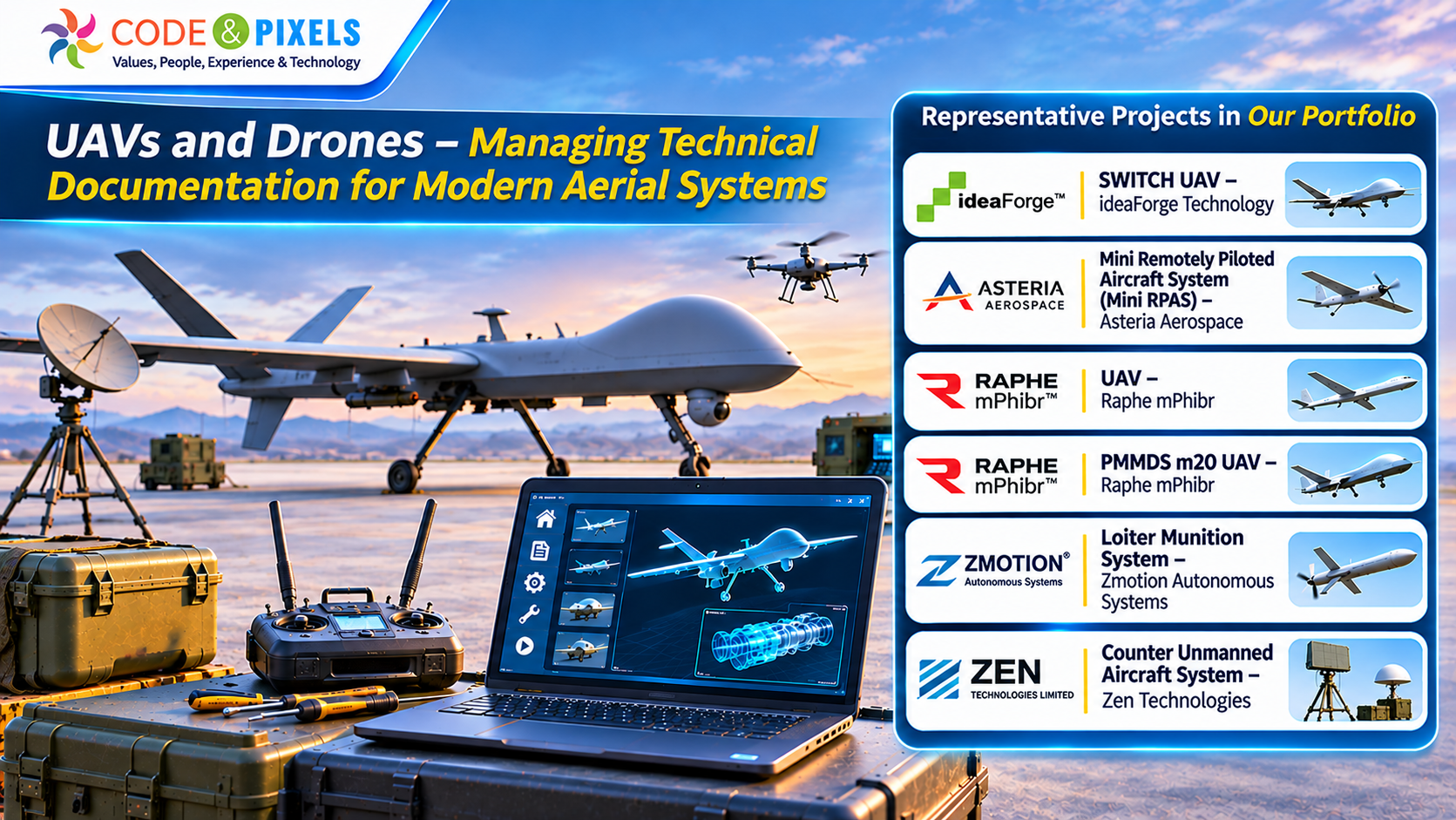
Case Study 4: UAVs and Drones – Managing Technical Documentation for Modern Aerial Systems
Representative projects in the Code and Pixels portfolio:
- SWITCH UAV – ideaForge Technology.
- Mini Remotely Piloted Aircraft System (Mini RPAS) – Asteria Aerospace.
- UAV – Raphe mPhibr.
- PMMDS m20 UAV – Raphe mPhibr.
- Loiter Munition System – Zmotion Autonomous Systems.
- Counter Unmanned Aircraft System – Zen Technologies.
The documentation challenge
Unmanned aerial systems involve multiple interconnected subsystems, including airframes, propulsion arrangements, electrical systems, power supplies, communication equipment, ground support equipment and control systems.
The associated documentation must explain system operation, inspection, maintenance, component replacement and relevant technical limitations.
As UAV technology develops, maintaining clear and current technical documentation becomes increasingly important.
How IETM helps
An IETM can organize UAV technical publications into logical modules covering:
- Aircraft and subsystem descriptions.
- Ground support equipment.
- Operating instructions.
- Inspection and maintenance procedures.
- Electrical and mechanical drawings.
- Component information.
- Troubleshooting references.
- Technical videos and illustrations.
- Revision history.
For example, personnel looking for information about a ground support subsystem can directly access the relevant module instead of searching through an entire collection of publications.
Where appropriate, interactive drawings and multimedia can provide additional clarity.
The practical benefit
IETM provides a structured technical knowledge base for complex unmanned systems and helps OEMs deliver organized documentation to their end users.
This is particularly valuable as defence UAV programmes expand and their supporting technical documentation grows.
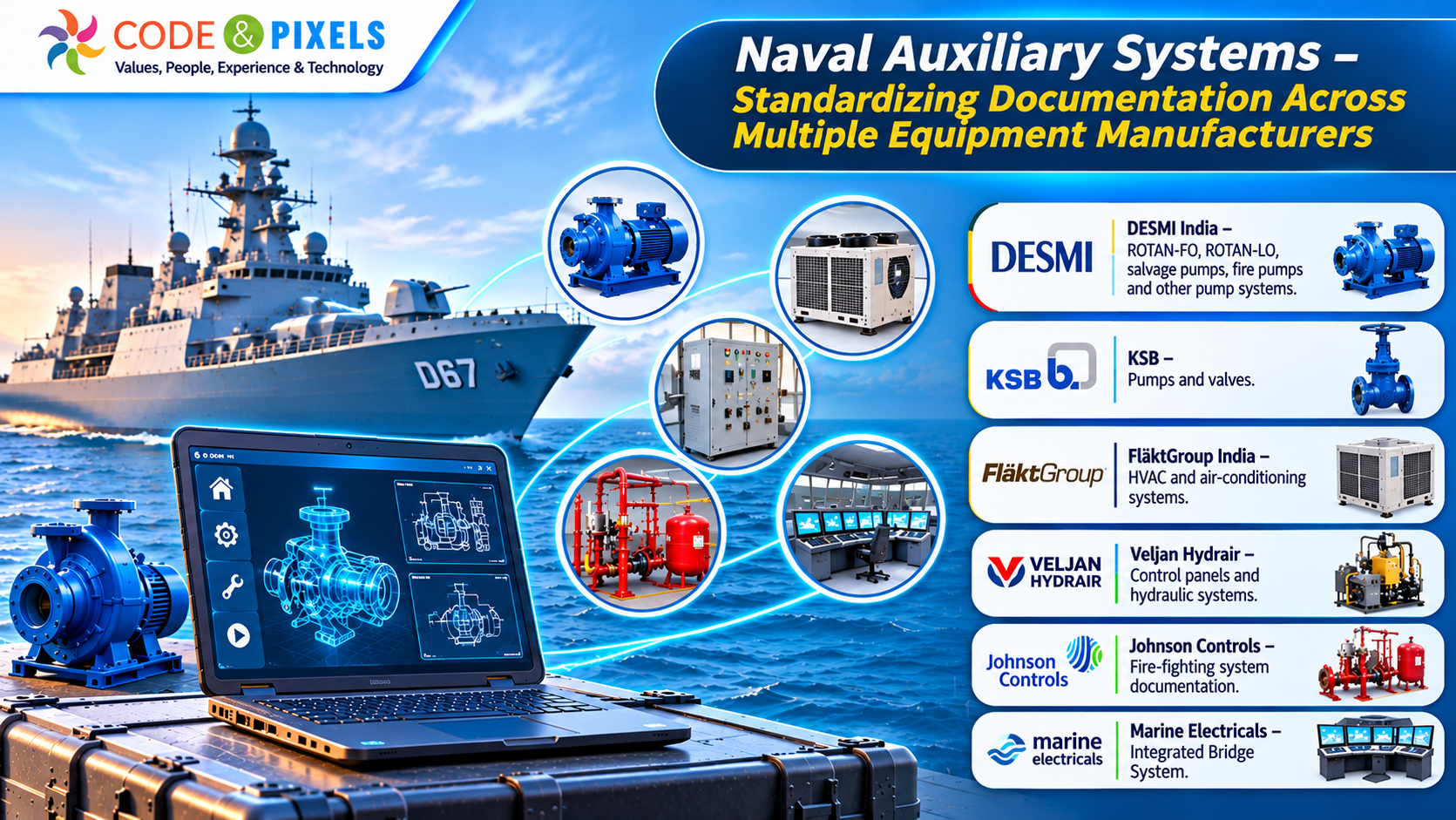
Case Study 5: Naval Auxiliary Systems – Standardizing Documentation Across Multiple Equipment Manufacturers
Representative projects in the Code and Pixels portfolio:
- DESMI India – ROTAN-FO, ROTAN-LO, salvage pumps, fire pumps and other pump systems.
- KSB – Pumps and valves.
- FläktGroup India – HVAC and air-conditioning systems.
- Veljan Hydrair – Control panels and hydraulic systems.
- Johnson Controls – Fire-fighting system documentation.
- Marine Electricals – Integrated Bridge System.
The documentation challenge
A naval vessel may incorporate equipment from several specialized manufacturers.
Each manufacturer provides its own technical manuals, drawings, maintenance instructions and operating procedures.
For the end user, managing this information as separate publications can make technical reference more difficult.
How IETM helps
An IETM can bring the equipment documentation into a structured digital environment.
For a pump system, the documentation can include:
- Equipment description and specifications.
- Operating instructions.
- Maintenance schedules.
- Component drawings.
- Inspection procedures.
- Troubleshooting references.
- Supporting manuals and videos.
The same approach can be followed for HVAC systems, fire-fighting equipment, control panels and other auxiliary systems.
The practical benefit
Each equipment package retains its technical identity while becoming part of a more organized digital documentation environment.
For shipyards and system integrators, this provides a practical approach to managing technical publications from multiple OEMs.
Learn More or Request a Demo
Website: www.codeandpixels.net
Email: ietm@codeandpixels.net
Phone: +91 98495 27706
 |
GOPI KRISHNA GUDIVADA Leading the R&D and Project divisions at Code and Pixels and Digital Teacher, driving innovation in e-learning, IETM software, and Defence documentation solutions. With 23 years in content development and 15 years in Defence technical documentation, I bring deep expertise in designing and implementing IETM solutions aligned with JSG 0852 and S1000D standards. Passionate about creating world-class digital training systems for the Indian Armed Forces and advancing the standards of e-learning in India.    |


